
Design and Integration of Chassis and Power-train for a Range Extended Electric Vehicle
Developing a REEV prototype for areas with limited charging infrastructure, combining electric propulsion with an engine-driven generator. FYP-1 established the architecture and integration methodology.
Engineering case study
The engineering brief
How can a REEV prototype retain electric propulsion while reducing dependence on charging access in areas with limited charging infrastructure?
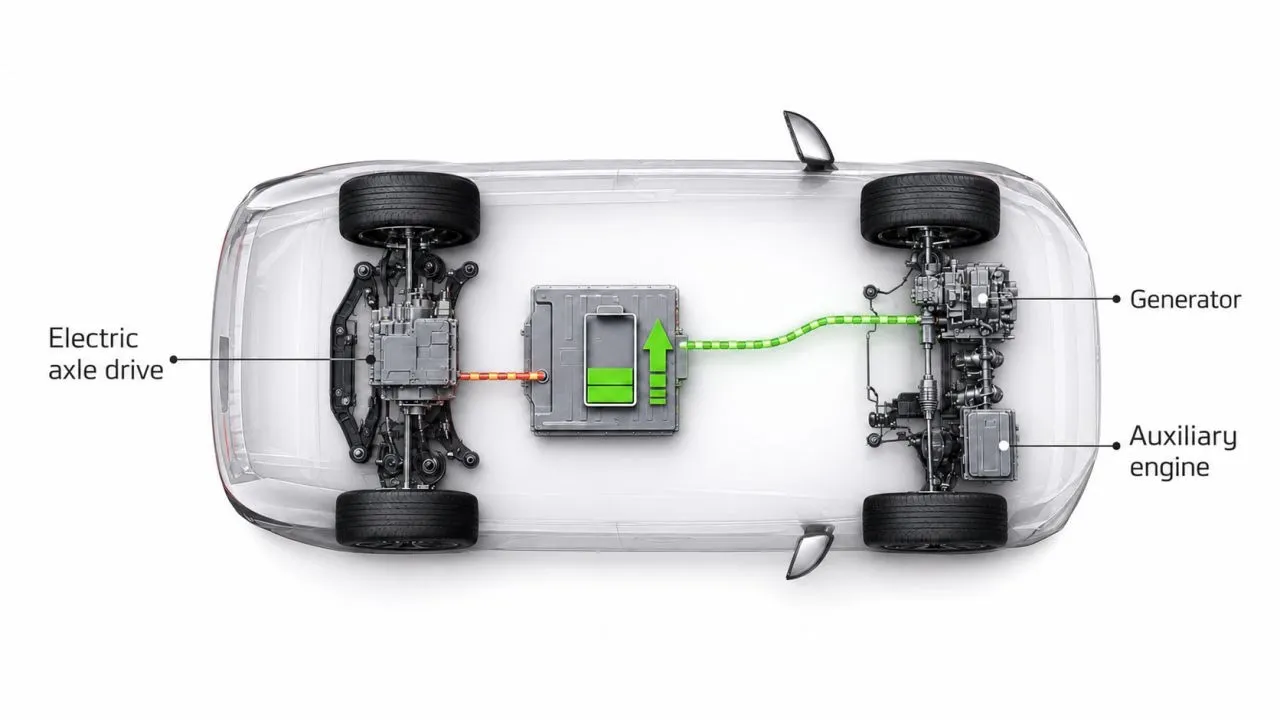
Developing a range-extended electric vehicle (REEV) prototype for areas with limited charging infrastructure at Air University, Islamabad. The selected series architecture keeps the wheels electrically driven: the battery supplies a controller and traction motor, while a petrol engine runs a generator to support or recharge the electrical system when required. The engine has no direct mechanical connection to the wheels. A longer-term ambition is to build a startup that converts existing vehicles into REEVs; that conversion service is future work, not an available product.
Series architecture & integration
- Compared battery-electric, hybrid and range-extended concepts through a literature review, then selected a series architecture for the proposed REEV prototype.
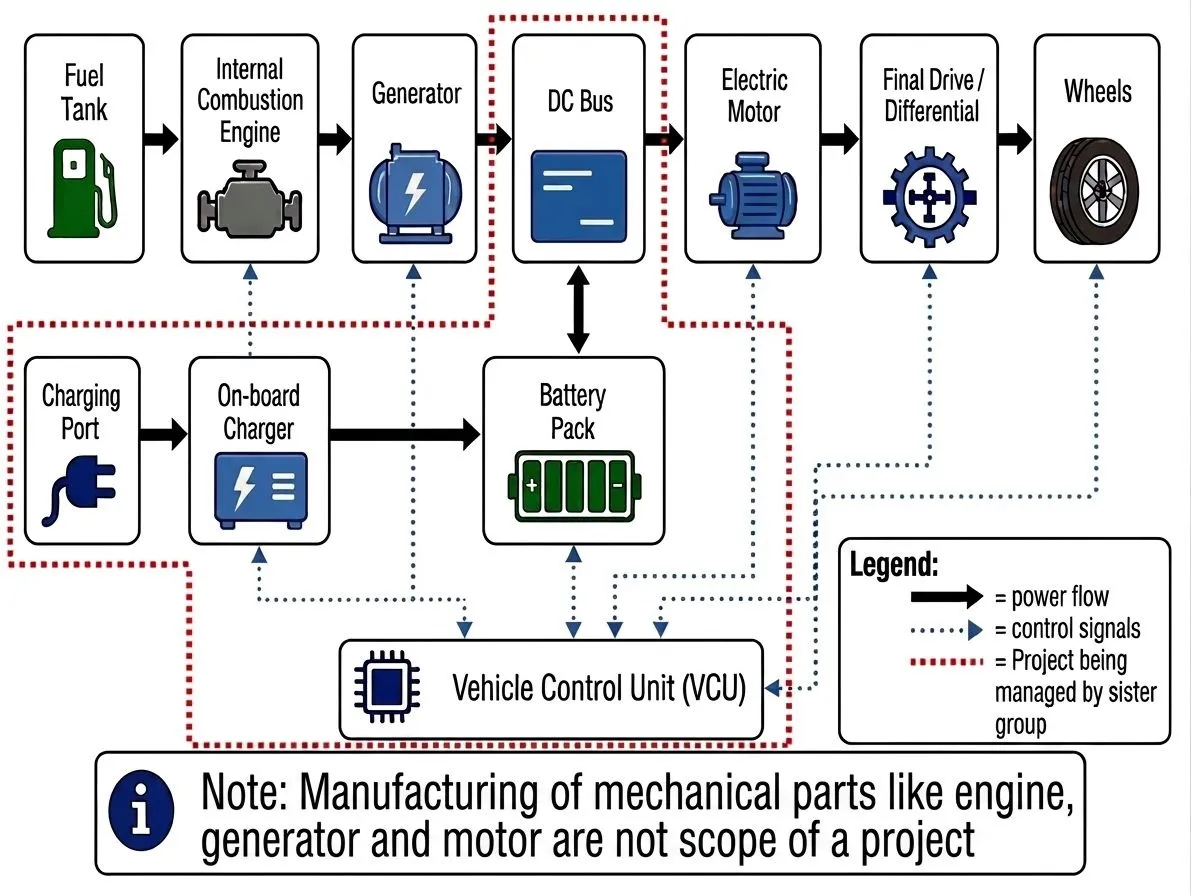
- Defined the traction path as battery/DC bus → motor controller → electric motor → final drive and wheels. The engine-generator branch supplies electrical energy to the DC bus or battery; there is no mechanical engine-to-wheel path.
- Identified the battery, traction motor, controller, petrol engine, generator, fuel tank and DC/DC converter, relating selection to voltage, current, torque and auxiliary-load requirements.
- Set out a sizing method using vehicle mass, speed, acceleration and wheel radius for traction requirements, followed by battery voltage, current and energy-capacity considerations. Final compatible values remain later-phase work.
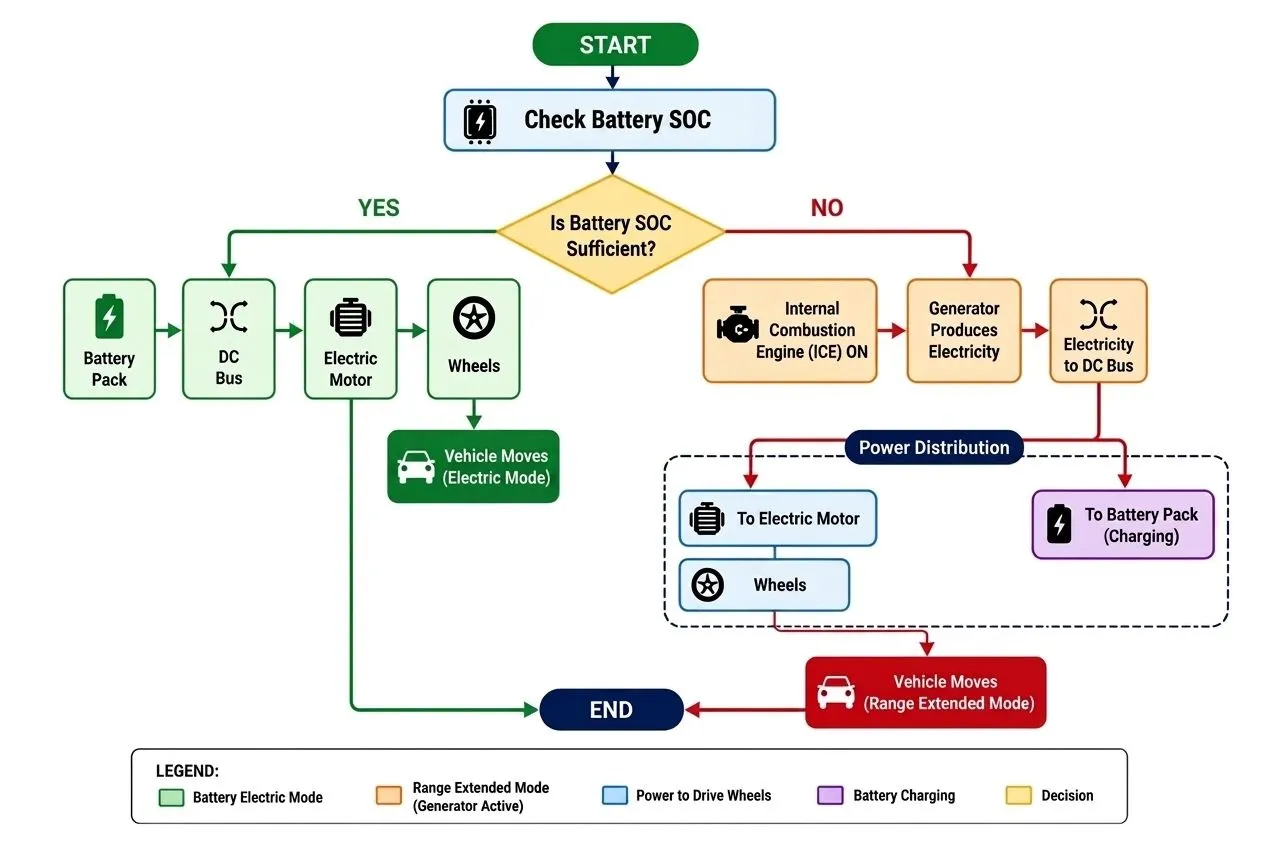
- Defined integration and evaluation methodology around motor operation, battery support and generator charging response, with a conceptual state-of-charge flowchart for electric and generator-supported modes.
Design constraints
- Battery, motor, controller and generator choices must form a compatible electrical system; the current deliverable establishes the selection method rather than a final hardware specification.
- The project concerns component selection and integration. Manufacturing an engine, generator or traction motor is outside its stated scope.
- The engine-generator range extender uses petrol, so the architecture is not a zero-emission vehicle claim.
What FYP-1 established
- FYP-1 completed the literature review, architecture selection, component identification and sizing/integration methodology.
- The block diagram and state-of-charge flowchart explain the proposed energy and control paths. The vehicle rendering communicates the concept, not completed construction.
- No achieved driving range, finalized component ratings or completed vehicle demonstration is claimed.
Engineering takeaways
- A series architecture separates mechanical propulsion from the range extender: both energy sources support one electric traction path.
- Component sizing and integration must be considered together, rather than selecting a motor, battery and generator independently.
The remaining academic phases
- FYP-2: carry out the design calculations and component sizing for the selected REEV prototype architecture.
- FYP-3: develop the planned prototype, integrating the chassis and power-train and documenting its operation.
- Longer-term vision: explore a startup that converts existing vehicles into REEVs. The startup has not launched, and commercial availability, road legality, range, efficiency and certification are not established.
Visual record
Images & diagrams
Continue exploring
More engineering work
Power systems
Micro Hydropower Plant
A completed rural-electrification design study for Kewai Village, Naran, covering the water-to-wire system and its environmental and economic feasibility.
View projectEmbedded systems
Multi-Sensor Navigation Robot
An implemented Arduino semester prototype combining line tracking, obstacle sensing and ambient-light response through embedded control.
View projectPower systems
Single-Phase Center-Tapped Transformer
An Electric Machines design-and-fabrication project connecting winding calculations with bobbin availability, core fit and practical redesign.
View project