
34 kW Micro Hydropower Plant Design
A completed rural-electrification design study for Kewai Village, Naran, covering the water-to-wire system and its environmental and economic feasibility.
Engineering case study
The engineering brief
Develop a feasible local-generation design for rural electrification in Kewai Village, Naran, connecting the available water resource with community electricity demand.
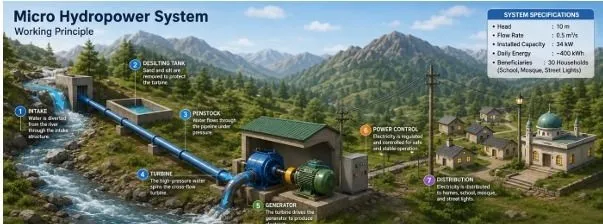
This Complex Engineering Project studied a 34 kW micro hydropower scheme for rural electrification in Kewai Village, Naran, Khyber Pakhtunkhwa. The work connects resource and load assessment with turbine-generator selection, civil arrangements, electrical distribution and implementation planning. It is a design study; the illustrations do not establish a constructed or commissioned plant.
From water resource to electricity
- Started with head/flow assessment and village load assessment so the generation concept addressed both the water resource and electricity demand.
- Selected a cross-flow turbine and a 35 kW induction generator for a scheme with a 34 kW design capacity. The generator selection and plant design capacity describe different parts of the design.
- Developed the water-to-wire chain: intake and conveyance, penstock, powerhouse, turbine-generator set, controls, transformer and distribution network.
- Brought technical choices into a feasibility assessment covering costs, implementation planning and environmental/economic considerations.
Design constraints
- Resource assessment, civil layout and electrical distribution must be considered as one system rather than treating generator selection as the whole plant.
- Annual generation and payback depend on the study assumptions; they are projections rather than operational records.
Work & results in context
- Completed the academic design study for a 34 kW micro hydropower scheme.
- Projected approximately 146,000 kWh annual generation and a payback below two years under the study assumptions.
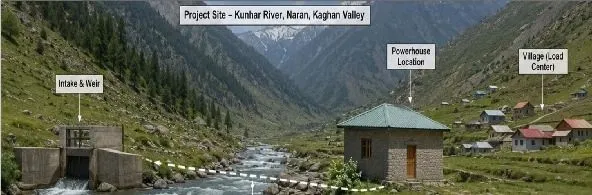
- The illustrations describe the proposed system and site arrangement. Construction and commissioning are not established by this design record.
Engineering takeaways
- Rural electrification design connects generation equipment with the civil works, controls and distribution needed to serve a community.
- Technical capacity, expected energy delivery and economic feasibility are different design questions and need to be reported separately.
Figures in context
Visual record
Images & diagrams
Continue exploring
More engineering work
Electric mobility
Range Extended Electric Vehicle
Developing a REEV prototype for areas with limited charging infrastructure, combining electric propulsion with an engine-driven generator. FYP-1 established the architecture and integration methodology.
View projectPower systems
Single-Phase Center-Tapped Transformer
An Electric Machines design-and-fabrication project connecting winding calculations with bobbin availability, core fit and practical redesign.
View projectPower systems
Substation & Distribution Design
An academic layout and distribution study for mixed residential, industrial and commercial loads, using load curves to guide equipment ratings.
View project